
H.N. Sharma
– A Direct Conversation with Youth India News Group Editor-in-Chief Sharad Katiyar at Chandra Shekhar Bhavan, New Delhi
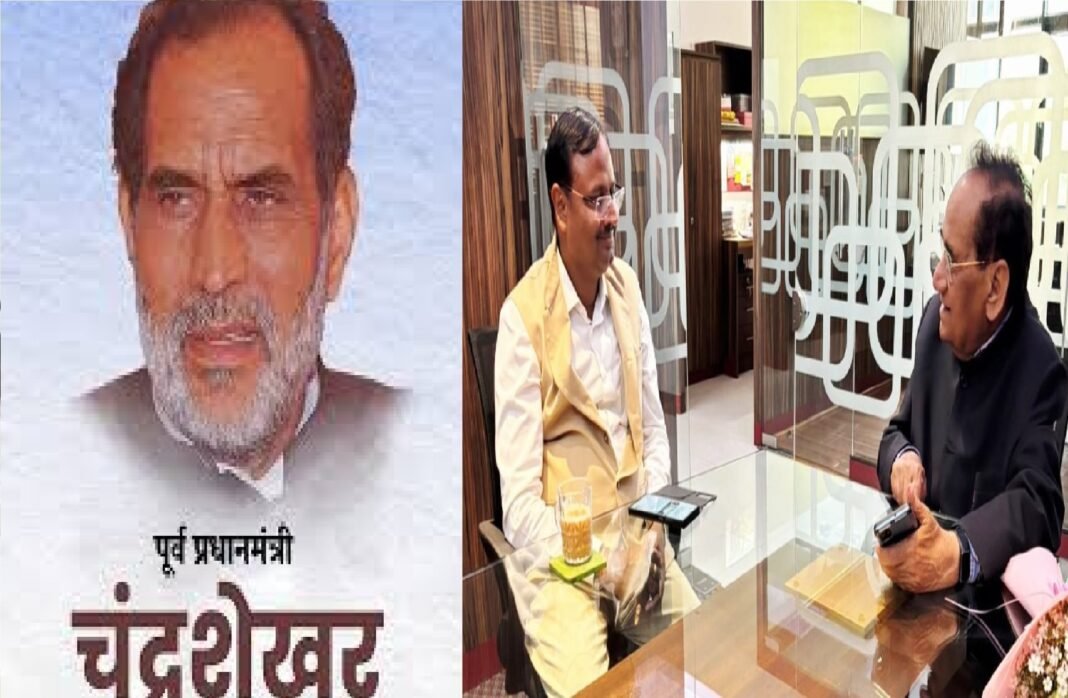
New Delhi.The walls of Chandra Shekhar Bhavan at ITO stand as silent witnesses to an era when politics revolved around ideas, courage, and self-respect. When Youth India Editor-in-Chief Sharad Katiyar met H.N. Sharma—renowned thinker and former political advisor to the late Prime Minister Chandra Shekhar—the interaction became more than a recollection of memories; it felt like turning the living pages of history.
H.N. Sharma, widely regarded as a serious political analyst and guiding intellectual voice, spoke with deep emotion: “I have been with him since 1964. I saw his struggles, his imprisonment, his tenure in power—but above all, I witnessed his simplicity.” According to Mr. Sharma, the title ‘Youva Turk’ was not merely a political label—it was a reflection of Chandra Shekhar’s fearless character.
“Even within the Congress, he was outspoken. He questioned power. Compromise was never in his nature. For him, politics was service, not prestige.” He emphasized that Chandra Shekhar believed power was only a means, never the ultimate goal. “He Never Visited a CM or Governor’s Office”
Recalling a striking historical detail, Sharma shared:
“He never stepped into a Chief Minister’s or Governor’s office for a formal visit. He only went to file nominations. If he ever walked directly into a government office, it was the Prime Minister’s Office—and that too when he himself became Prime Minister.”
This, Sharma noted, symbolized his deep sense of political self-respect and independence.
The Emergency of 1975: A Test of Conviction
When the conversation turned to the Emergency of 1975, Sharma’s voice grew heavy.
“Democracy was being strangled. He was arrested. He even went to the police station once during that dark period. But he never bowed. For him, democracy was not a slogan—it was life itself.” Prison walls, Sharma said, could not confine his convictions.
Hailing from Ganga Pur village in Ballia district of Uttar Pradesh, Chandra Shekhar rose to national prominence while remaining rooted in rural India. Mr.Sharma himself, now a respected national figure, continues to receive visitors from Andhra Pradesh, Kanyakumari, Tamil Nadu, and beyond. Recently, he even met with visiting international dignitaries, reflecting the continued relevance of his counsel.
“Even after becoming Prime Minister, he never forgot the village. His diaries reflect the pain of farmers, the poor, and the democratic spirit,” Sharma noted.
Mr.Sharma highlighted another remarkable fact:
“Even as Prime Minister, he chose not to permanently reside in the official residence. He believed in simplicity. His life’s message was that principles are greater than position.”
H.N. Sharma remains a widely respected public intellectual. Leaders across party lines acknowledge his clarity of thought and commitment to democratic dialogue.
With humility, Sharma remarked:
“Whether it is Prime Minister Narendra Modi or Uttar Pradesh Chief Minister Yogi Adityanath, national leaders understand the importance of dialogue. Democracy derives its strength from conversation.” He added that Chandra Shekhar’s legacy was rooted in open dialogue and ideological clarity—qualities essential for keeping democracy alive.
A Moment of Reflection
As the interview drew to a close, Sharma paused for a few seconds. Then, in a soft but firm voice, he said: “Politics may have changed today. But leaders like Chandra Shekhar are not just history—they are inspiration. He did not chase power; he stood by principles.”
The photographs on the walls of Chandra Shekhar Bhavan seemed to echo his words—reminding us of a Prime Minister who valued ideas more than authority.
This conversation was not merely an interview; it was a living document of an era when politics meant dignity, conviction, and unwavering ideological commitment.